

Emergency
Five minutes of knowing where the tap is will save you thousands in damage. Find what’s happening below, do the steps, and ring us once it’s stopped - nothing gets worse while the water’s off.
1300 420 911We answer the phone 24 hours a day, seven days a week. If it is an emergency, call rather than booking online. If it can safely hold until morning (a dripping tap you have isolated, a slow drain that still drains, a quote) then book online and save the after-hours call-out for when it counts. Not sure which one you have? Call anyway and we will tell you honestly.
Water and electricity, before anything else
If water is near a powerpoint, a light fitting or the switchboard, do not stand in it and do not touch anything electrical. Switch the power off at the board only if you can get there without walking through water. Otherwise leave the house and ring us from outside. A flooded floor is a repair. An electric shock is not.
Water is pouring out and I can't stop it
Turn the water off at the meter, out at the front boundary.
If water is anywhere near a powerpoint, the switchboard, or a light fitting, do not stand in it. Turn the power off at the switchboard first if you can reach it while staying dry. Otherwise leave the house and call us from outside.
- 1
Go to the water meter.
Almost always at the front boundary near the footpath, in a rectangular box at ground level. Lift the lid - it is often full of dirt, leaves or spiders.
- 2
Find the valve and work out which type you have.
There is more than one kind. A T-shaped handle like a tap, a black plastic handle, a metal lever, or - the annoying one - a flat metal bar that usually will not turn by hand. If there is a valve either side of the meter, it does not matter which you use: both stop the water to the house.
- 3
Turn it clockwise until it stops.
Handles and levers turn by hand; a lever sits across the pipe when it is shut. For the flat metal bar you will need tools - two shifting spanners, or a shifter and a screwdriver for leverage, is what we use. Steady pressure, not brute force. Snapping the valve off turns a leak into a much bigger job.
- 4
Check the water has actually stopped.
Open a tap inside. It should run for a second and then die. If it keeps running, the valve has not fully closed - go back and give it the rest of the turn.
- 5
Now call us.
With the water off nothing is getting worse. Tell us it is off and roughly where the leak was.
An open water meter box, shot from standing height as the customer would see it. Ideally more than one photo here - the different valve types are the whole point: a T-handle, a black plastic handle, a metal lever, and the flat metal bar that needs shifters. A hand or a shifter on the valve makes it obvious.
Once it’s stopped
Once it is off you can leave it off safely. You just have no water until we get there. We carry the common repair fittings, so most burst pipes are a same-visit fix.
I can smell gas
Judge how strong it is - that decides what you do next.
Whatever the strength: no naked flames, no cigarettes, and do not go looking for it with a lighter. If the smell is strong, do not touch light switches or powerpoints either - a switch makes a small spark, and in a room full of gas that is enough.
- 1
First, work out how bad it is.
There is a big difference between catching a faint whiff by the cooktop for a second and walking into a house that reeks of it. Gas is deliberately given that rotten-egg smell so you can tell - trust your nose. Faint and near an appliance is a check-it-out. Strong, spreading, or in a room with no gas appliance in it, is a get-out.
- 2
Faint smell near a gas appliance: check the obvious first.
Usually a burner not quite lit, a knob left slightly on, or a pilot that has blown out. Turn the appliance off, open a window, and give it a few minutes. If the smell clears and does not come back, it was the appliance - still worth getting looked at, but not an emergency.
- 3
Smell persists, or is strong: turn the gas off at the meter.
The meter is usually on an external wall. There is a lever or a tap on the pipe into it - a quarter turn so the handle sits across the pipe shuts it off. Open some windows and doors on your way through.
- 4
Strong smell, or it keeps getting worse: get everyone out.
This is the one where you stop doing anything clever. People outside first, no switches touched, phone used from outside. If it is strong enough that the house smells of it, ring 000 - that is a fire service job before it is a plumber's.
- 5
Then call us.
We are licensed gas fitters. We will find the leak, repair it, test the line properly and issue the compliance paperwork.
A domestic gas meter on an external wall with the isolation lever clearly visible, ideally mid-turn so the closed position reads obviously. Include enough wall for context.
Once it’s stopped
If you shut the gas off at the meter, do not turn it back on yourself. Appliances need to be relit and checked once the supply has been off, and that is the part where people get hurt. A pilot that will not stay lit is also worth a look - it is often the thermocouple, which is a cheap fix.
My hot water system is leaking
Find the cold water inlet valve and shut it off.
The water inside is hot enough to scald badly. Do not put your hands near a leak that is steaming, and keep children and pets away from it.
- 1
Work out whether it is actually a fault.
A slow drip from the small relief valve on the side, especially while the unit is heating, is normal. That valve is doing its job. A steady stream, or water pooling under the tank, is not.
- 2
Turn off the cold water going into it.
Look for a valve on the cold inlet - the pipe feeding water into the unit. It is often near the top, but not always: on some installs it is down low, tucked behind the unit, or a little way along the wall. There should be one somewhere on that line. Turn it clockwise. If you cannot find it, shut the water off at the meter instead and ring us.
- 3
Turn off the power or the gas to it.
Electric: switch it off at the switchboard, where there is usually a labelled breaker or an isolator switch on the wall near the unit. Gas: turn the small tap on the gas line into the unit.
- 4
Leave the water in it.
You do not need to drain the tank, and draining a hot one is a good way to scald yourself. Just leave it.
- 5
Call us and tell us the brand.
The brand and rough age is on a sticker on the front. Tell us that on the phone and there is a good chance we arrive with the right part on the van.
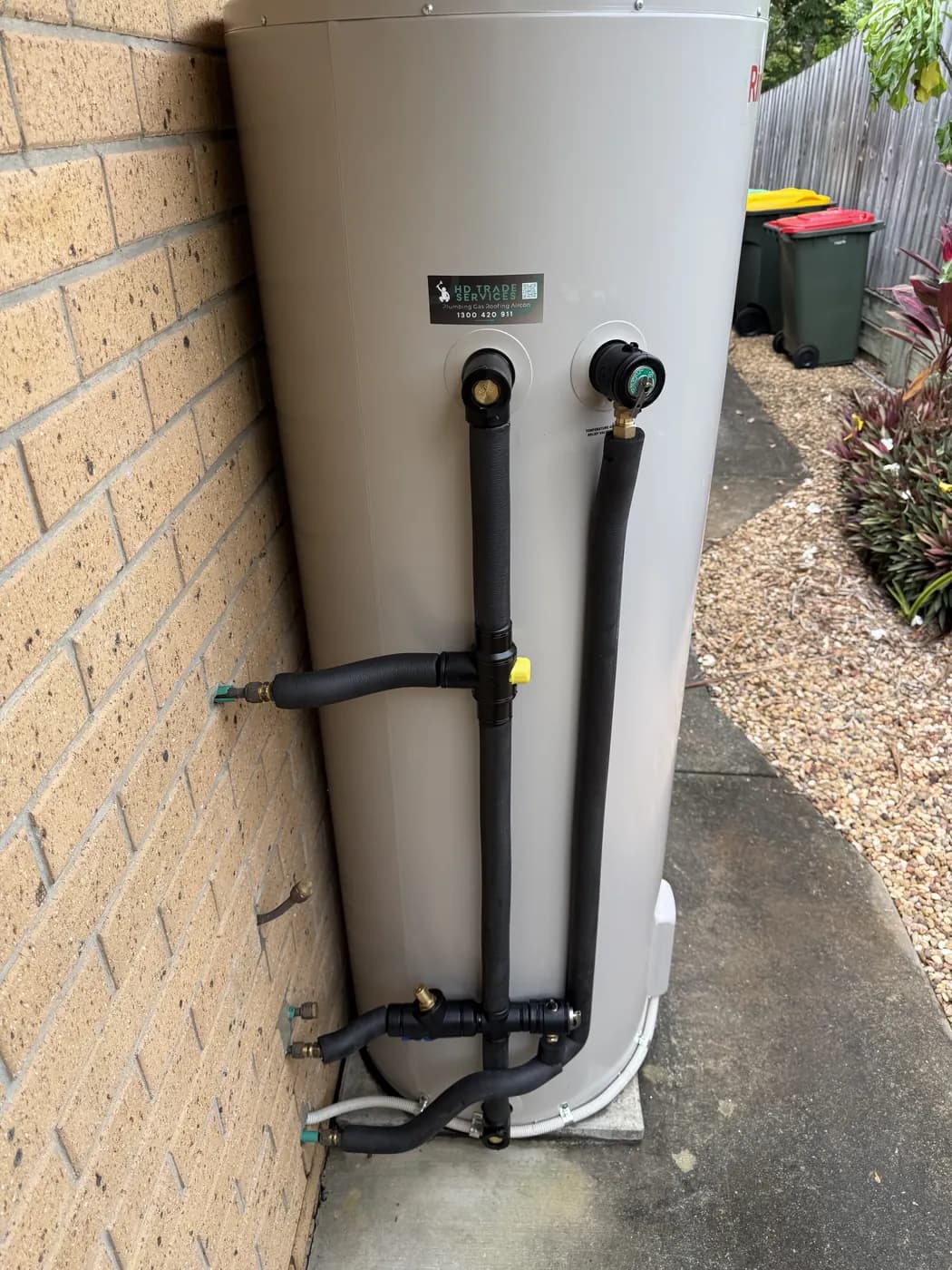
Once it’s stopped
Water pooling underneath usually means the tank itself has rusted through, and no repair fixes that. A leak from a valve or a fitting is a straightforward repair. We will tell you which one you have got before you spend anything.
The toilet or drain is overflowing
Stop using every tap in the house. All of it goes to the same place.
Treat overflowing sewage as a health risk. Keep kids and pets out of it, and wash properly afterwards.
- 1
Stop using water anywhere in the house.
No showers, no washing machine, no dishwasher, no flushing. Every one of those drains into the same blocked line and adds to what is coming out.
- 2
If it is the toilet, turn off the tap behind it.
There is a small isolation tap on the wall or floor behind the pan. Clockwise. That stops it refilling if someone flushes out of habit.
- 3
Find the overflow relief gully outside.
A grate at ground level outside, lower than the lowest fixture in the house. It is designed to overflow out there instead of inside. If it is spilling, that is the system working as intended, and it confirms the blockage is in the main line.
- 4
Clear anything blocking that grate.
Leaves, dirt, a pot plant sitting on top of it. Keeping it clear is what stops sewage coming up through your shower instead.
- 5
Call us.
A blocked main line needs a drain machine or a camera. Supermarket drain chemicals will not shift tree roots, and they make the job unpleasant for whoever opens it up.
An overflow relief gully grate at ground level beside a Brisbane house. Ideally one clear shot and one showing it blocked with leaves, to make the contrast obvious.
Once it’s stopped
If it has happened more than once in the same year, the line has a problem, usually roots or a collapsed section. A camera down the drain tells us which, and that is worth doing rather than paying to clear it every few months.
Water is coming through the ceiling
Get the ceiling drained before it collapses, and stay off the roof.
Do not get on the roof in the wet. Wet metal roofing in Brisbane rain is dangerous, and a fall costs far more than a ceiling. Nothing up there is worth it.
- 1
Turn the power off to that part of the house.
Water tracks along ceiling joists and finds light fittings. If water is anywhere near a downlight, kill the circuit at the switchboard.
- 2
Put a bucket under it and move what you can.
Furniture and electronics out from underneath first.
- 3
If the ceiling is bulging, pierce it deliberately.
A sagging, heavy patch means water is pooling above the plasterboard. A small hole with a screwdriver at the lowest point, with a bucket under it, drains it in a controlled way. Left alone, the whole sheet can come down at once.
- 4
Photograph everything now.
Before you clean up. If you end up making an insurance claim, the photos taken while it is happening are the ones that matter.
- 5
Call us once the rain eases.
We will find the entry point, which is often nowhere near where it is dripping inside, and make it watertight.
A water-stained or bulging ceiling from a real job, before repair. Honest and unstaged is better than tidy here.
Once it’s stopped
Water rarely enters where it appears. It runs along battens and joists before it drops, so the stain is a clue rather than an answer. That is why we look at the whole roof rather than the spot underneath.
Stopped the water? Good. Now let’s fix it.
Licensed plumbers and gas fitters, on call around the clock across Brisbane, Ipswich, Logan and Moreton Bay. Gold Coast after hours, ring and ask.
1300 420 911Not urgent? Book online instead.